
In my two previous posts about the Spiel des Jahres and the Kennerspiel des Jahres, I went over this year’s nominee and recommended lists for both the Game of the Year and the Connoisseur Game of the Year awards. To wrap up this mini-series of posts, this entry will offer an analysis / exploration into the games the jury put on the Kinderspiel list – the Children’s game of the year. All these awards are due to have the winners announced on Sunday 21st July.
The children’s game of the year isn’t usual a category I’d look into much (my kids have long since outgrown this level of game), however it felt incomplete to not look at them. So let’s see what we have!
Kinderspiel des Jahres Nominations
Große Kleine Edelsteine (Big Little Gems)
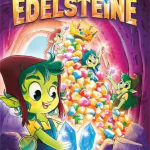 (Wolfgang Warsch; Schmidt)
I do love a good rhyming title, and the German title “Große Kleine Edelsteine” is just such an example; it’s just beautiful wordplay (side-note: Still my favourite German title rhyme is the game Geister, Geister, Schatzsuchmeister, aka Ghost Hunting Treasure Hunters).
The title in English though? Not so poetic.
But what’s this game about? It is designed by the great Wolfgang Warsh (of many games I’m sure readers know, such as Quacks of Quedlinburg, That’s Pretty Clever, Taverns of Tiefenthal), a designer with a great breadth of design styles, themes and complexities. This children’s game entry is no different…
At its core it’s a size-matching game – 81 unique gem tokens are placed facedown around the play area, then in each round, 3 cards are revealed which each show a shape (one of 9 shapes) and a size (one of 9 sizes – each shape has one of the 9 sizes (identified by a symbol to help with colour-blind players), meaning all 81 gem tokens are unique). Everyone simultaneously has to grab 2 gems they think should fit the shape and size shown on any of the 3 cards. Once done, everyone reveals: If you matched the card’s gem exactly, you win the card, which is worth points! If you were just one size out, you get a 1/3 piece of a magnifying glass – claim 3 of those and you exchange them for a facedown card from the pile, which is a nice little catch-up mechanism (which Warsh is really good at doing). Cards have 1-3 stars on them, and after 6 rounds, whoever collected the most stars wins the game!
This is an easy-going game, which isn’t so much a mad scrabble for the gems as you’d think – it’s not Galaxy Trucker levels of panic-grabbing a tile, rather you can take a fairly considered time to pick a gem. And the little catch-up mechanism means kids won’t feel like they’ve completely lost out if they don’t get something exactly on, as does having 3 cards to aim for but only needing to take 2 gems, which means no-one should be completely excluded from getting an exact or near-exact match for one of those.
It’s a lovely little game which further shows the genius of Warsch’s design pedigree.
Die Magischen Schlüssel (The Magic Keys)
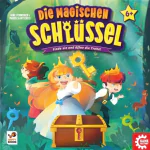 (Markus Slawitschek & Arno Steinwender; Game Factory / Happy Baobab)
Back in the days when my kids would play Kinderspiel level complexity games, we had a game called Der Verzauberte Turm (The Enchanted Tower), where two players were, respectively, roll 2 dice and pick whether to move the Prince or the Wizard backwards or forwards around various paths, intent on being the first to find/get the key to the tower the Princess is locked in to release her / keep her locked up. To do that, you moved around the map trying to find the key hidden under the board (using magnets under the playing pieces), and once found by the Prince, you’d try one of the 6 “locks” on the tower to try unlocking the princess.
This game, The Magic Keys, reminds me a lot of that, with the same idea of using the game box to contain the track and keys, except here you have loads of keys, and there’s no princess in sight – you’re just trying to get treasure. Yes, it’s pure greed, folks, driving you in this game! You roll 3 dice, hoping to get movement points; one side of each die is a “snoozing” icon, which “locks” that die. You then must pick one of dice to move the indicated number of steps on that die along a path; you can then choose to reroll any non-snooze-faced dice to try moving again, and so on, until you either choose to stop rolling, or all 3 dice are snoozing.
If you roll 3 snooze faces on your first roll of your turn, you get to teleport to the princess space (about 1/3 of the way up the track); in that case, or if you land on that space in normal movement, you get to reroll all your dice and keep going. When you decide to stop, if you didn’t bust, and you ended up on a space with a key, you try your luck using it on the treasure chest to see if it opens it – 3 out of the 5 keys per zone will unlock it (noting that used keys don’t get replaced), and here’s the key thing: The further along the track you go, the more treasure gems you get to take from the chest if it unlocks. So you can stop rolling early, for less gems but less chance of failing, or push your luck to go further for a better payoff, but at the risk of all your dice becoming locked. If you succeed in getting gems, or land on an empty space, or the key fails to open the chest, you return the character pawn (shared by all players) back to the start of the path; but if all your dice get locked, the pawn stays where it is, making it easier for the next player to push into the higher scoring zones with ease. And if you get right to the end of the track, you are guaranteed to open the chest for a nice big payout (that key is always returned to the board). Rinse and repeat until someone gets the required number of games (based on player count).
This is a really interesting way of doing a push-your-luck game for kids. You really want the big payouts, but it’s quite a risk to keep going up and up and up the track, as failure means the next player in turn order could get to the end really easily. And as the keys (except the last key) are not returned to the board, you’ll start getting to situations where maybe a whole zone has run out of keys, further encouraging you to keep pushing your luck. The components are also great – a large chest with loads of gems in, and the keys somehow are all identical yet only 3 of the 4 in each zone will open the chest (likely some magnet wizardry going on there). This is a really nice entry in the Kinderspiel!
Taco Katze Pizza Junior (Taco Kitten Pizza)
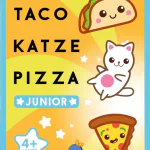 (Dave Campbell & Thierry Denoual; Blue Orange)
Based on its big brother, Taco Cat Goat Cheese Pizza (which came out back in 2018), this game is a card shedding game which is a cut-down “streamlined” edition of the original, that makes it easier to play with kids.
In the original game, each player would have to say one of the words in the title, in order, whilst flipping a card from their hand, so player 1 has to say Taco and flip a card, then play passes on and player 2 has to say Cat and flip a card, etc. If at any point the word spoken matches the card flipped, all players have to slam the pile with their hand as quickly as possible – the last player to do so takes the whole pile into their hand. 3 special cards require everyone to act out an action then slam their hands on the pile (gorilla = beat chest, beaver = knock on wood, narwhal = clap hands above head). If you shed out, you keep “playing” (not flipping a card); the winner is then the first player who has shed out to then slam their hand on a matching card first.
In this “Junior” version, there are only 4 types of card – Taco, Cat, Pizza or Bonbon. Instead of following the game’s name sequence, on your turn you instead get to pick any of the 3 types – Taco, Cat or Pizza (handily listed on the card backs), to say while flipping a card. If you match what you flip, you get to go again, else it’s the next person’s turn, except if you flipped a Bonbon – in that case, everyone has to try to slap the pile – the first person to do so gets to go next. And that’s it – first to run out of cards wins.
This is a really clever way to simplify the original game to make it more kid-friendly. You don’t have to remember where in a chain of 5 words you are, you just pick one of the words. Matching is simpler – just get another turn. And only one “special” slap card (and no special action to do before it). I could see this working with just adults too, being so quick and simple. Sure it’s lighter than even Taco Cat Goat Cheese Pizza, but not that much lighter. And it’s great to see a pure card game on the nomination list too.
Kinderspiel des Jahres Recommendations
Fluffy Valley
 (Maxime Rambourg & Théo Rivière; Loki)
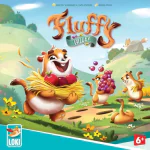
In this cooperative game, you are prairie dogs trying to collect enough grain, berries and honey to store in your burrow ready for winter. I mean, how utterly cute is that?! Well, not so fast – there’s also a fox which may steal your supplies, and an eagle that might capture a prairie dog and fly away with it (for a while, you’re not out of the game – the prairie dog somehow escapes the eagle’s clutches), not to mention badgers who steal food from the offering, and weasels which block holes. But I’m getting ahead of myself…
The game is another example of using the game box as the play area – the cute little prairie dogs sit in holes in that board, and there’s a slot where the circular food tokens can be “posted” in, which slide through the box and out onto the player board (which sits next to the box). On your turn, you take a heads-up prairie dog out of its hole, and place it head-down (bottom’s up!) into an empty hole, carrying out that hole’s action – yes, this is basically a worker-placement game. Once all prairie dogs are heads-down, the round ends. The actions for the different holes include gaining a token from the bag (could be a berry, a spoiled berry, etc), putting all face-up tokens of one type into the burrow, visit Mr Hedgehog’s store to exchange spoiled berries for other resources, gain a hay token, spend a hay token for an upgrade (small ongoing bonus) from Buster the Beaver, get Piper the Viper to scare off a weasel (remove weasel token from the board), dive in the river (to copy any action on a used (face-down prairie dog) space), or explore the tunnel (to get Honey, but risking finding a badger or a weasel instead).
The end of the round triggers an event (an eagle or fox may appear), then the prairie dogs flip back up ready for the next round. Keep going through 9 rounds; if you’ve collected all the food needed, you win!
This is indeed a very cute game. It has quite a bit of luck required to win (you need to explore the tunnel bag to get the 3rd honey you need, but there are a lot more badgers and weasels in that bag than honey!), but the Badger upgrade cards help mitigate that. I think this is a lovely introduction to worker placement (and some engine building). The need to upgrade to fully utilise luck mitigation is likely why this didn’t make it to be a full nominee, but it’s a lovely looking game nonetheless.
Lecker Lava (Delicious Lava)
 (Sophia Wagner; Three Magicians)
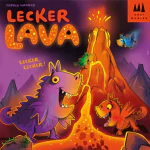
So this game apparently claims that dragons eat lava so they can power-up enough to fly a long way… Ooooookay. Designed by Sophia Wagner, who also designed the (much, much heavier) game Noria from 2017, this is the third game we’re looking at that uses the box as one of the components, and in this case it’s a volcano! Underneath the volcano top are a load of red, black, orange and yellow “lava” discs, which follow certain paths out in an almost coin-pushing-arcade-game style. The dragons want the hot lava (with hottest to coldest being yellow > orange > red > black; black is “cold” and you don’t want that!). And the dragons are cute little 3D papercraft dragons with wide-open mouths, into which lava tokens will drop.
At the start of a round, players can move their dragon next to one of the “outflow” areas next to the volcano (one of the holes lava will come out of). You can see through a gap in the board what type of lava will come out of that outflow next. Then on your turn, you’ll roll the die and take that many lava tokens out of a bag. One token at a time, you will push one of the drawn tokens into a non-dragon-guarded outflow, which will inevitably push some of the existing tokens under the volcano out of other outflows – ideally into your waiting dragon’s mouth, but discs could also fall into other dragon’s mouths, or just spill out onto the table. Keep going in rounds until the draw bag is empty, then score up points based on the colour of lava eaten (black requires you to discard one of your most valuable tokens, so you want to avoid that!)
This is another sort-of push-your-luck game, but with the feel of a bit more randomness. The cuteness of the disc-pushing mechanism, coupled with the 3D dragons, makes this a delight to look at. Quite how strategic you can be in eating just the right kind of colour, I don’t know, but I can see kids really enjoying pushing discs in. It might get a little annoying if one side of the volcano is always spewing out lava for another player of course, but as you can pick where to push your drawn discs into, that is slightly mitigated – all sides should have a fairly balanced chance of eventually getting some tasty lava.
I’m not sure there’s quite enough here to keep interest after a few plays, but it’s a nicely produced game with a cute theme and quirkily fun mechanism.
Die Nadel im Heuhaufen (The Needle in the Haystack)
 (Thomas Sellner; Schmidt)
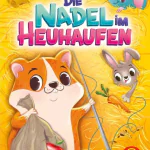
In this game, you will be literally searching for a needle in a haystack. Well, not a real haystack. And not a real needle. But the search is real! This is a cardgame in which you are taking advantage of Harry the Hamster’s bad luck – he has a hole in his sack, and it is spilling out his hard-foraged food all over the haystack, represented by an increasingly messy stack of cards. You want to find animal cards, or find their favourite food to steal that animal from another player, to score points at game end. If you find the needle, Harry is forever grateful and sews up the hole in his stack, ending the game after everyone has taken one final turn. Score all your animals for 1VP each, plus 3VP if you have the needle.
But the mechanism for gaining these cards? Well, you roll two dice and pick one. One lets you draw 4-6 cards from the deck, peek at them, then place them splayed out face-down on your hand and “throw” them a little into the air so they fall down onto/around the existing haystack (which starts with 3 roughly even, tidy piles). The other die lets you use the Pitchfork (another card) 1-3 times to “gather/flip” cards from the haystack over to hopefully be face-up, but you must do this with a single sweeping motion. Hopefully you find an animal card, which you can just grab, or else a food card an animal another player has can be enticed to you with. If you flip the Needle, everyone else gets a final turn then the game ends. There are also two Magnet cards which will allow you to steal the needle in that final round if you find it then.
So this is kind of a dexterity-ish set-collection-ish card game. And it sounds a little mean – stealing animals other players found, or even the needle at the end. But it’s light enough and cute enough that it shouldn’t cause too many tears. The one downside I can see is that the game can end early if you happen to find the needle early-game (which the rules acknowledge, and just suggest immediately playing again if that happens). I’m not sure why they didn’t get you to seed the needle into say the lower half of the draw deck, or even the middle, to guarantee some length of gameplay, but maybe that’s just too fiddly a setup for a kids game. Overall, I think this would go down well, provided your kids don’t mind having cards (that will score them points!) being stolen from them, back and forth, during the game. I’m not sure this is exactly Kinderspiel-recommended worthy, but who am I to complain when it’s a game which actively encourages you to throw the game’s components around!
My Pick for the Winner
Who I think will win
Die Magischen Schlüssel (The Magic Keys) – I think this has all the hallmarks of a classic kids’ game. It has just the right level of encouraging push-your-luck, mixed with unlocked-dice re-rolling a-la Escape: Curse of the Temple), to make this a worthy winner.
Who I would want to win
Taco Katze Pizza Junior (Taco Kitten Pizza) – I love simple cardgames that play easily and quickly with a whole range of people, especially non-gamers and young players, and this fits that bill perfectly. Sure it’s a little gimicky and lucky, but it harkens back to classic traditional cardgames like Slam which I used to play loads of. Give me that Taco-y Kitten-y Pizza-y fun any day!